
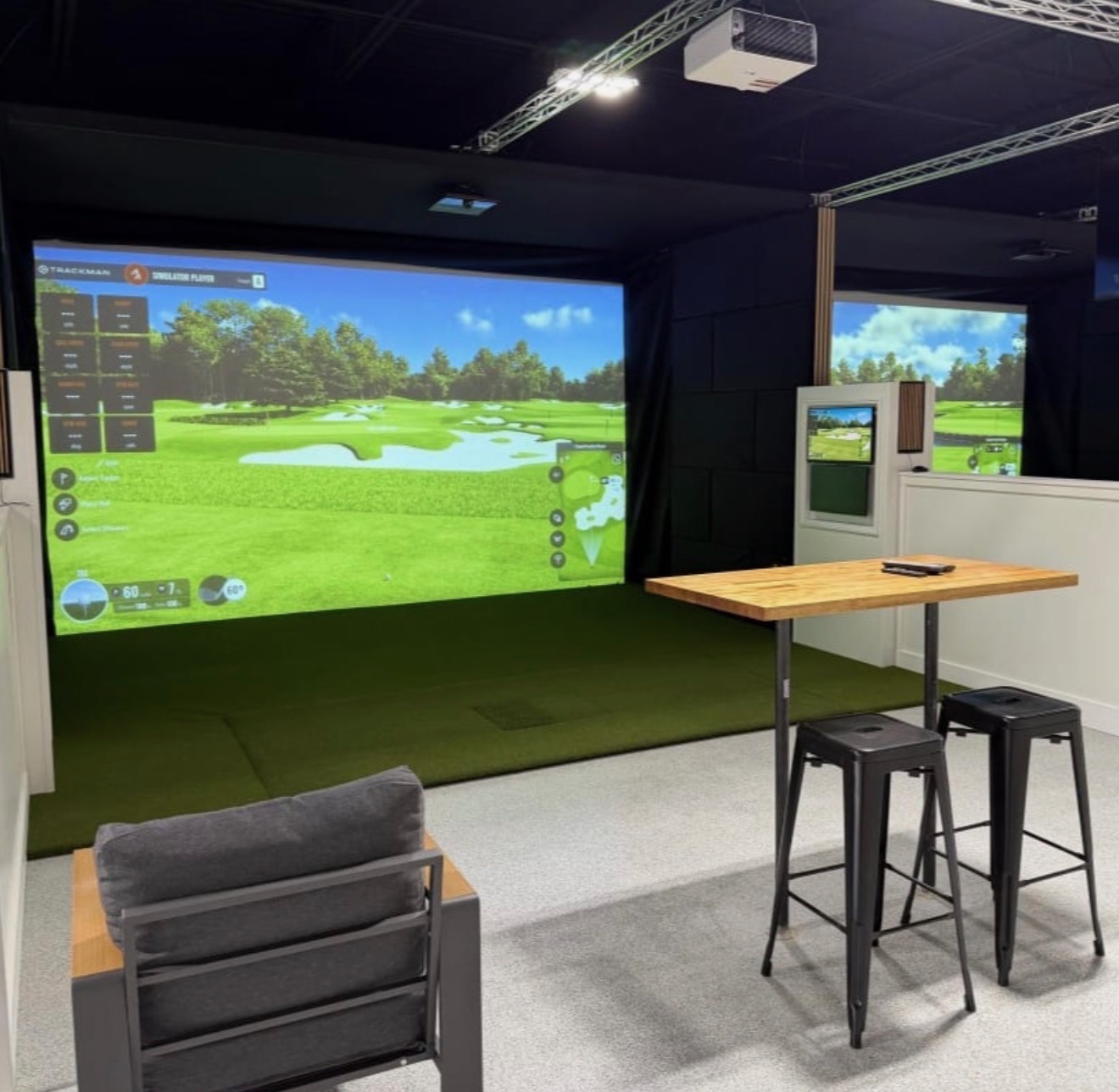
FROM OUR EXPERIENCE
At TruSim, we’ve helped set up simulator bays in everything from finished basements to commercial golf entertainment venues. One thing we notice consistently: most first-time buyers understand the concept of a simulator but don’t fully understand how the pieces interact — and that gap leads to purchasing decisions that don’t hold up once the equipment arrives. This guide is our attempt to close that gap.
A golf simulator is an indoor system that lets you hit real golf balls toward a large impact screen and see the resulting virtual shot play out on a projected golf course. But the experience you’re having is the product of a carefully coordinated set of technologies that must work precisely together. Understanding each layer makes you a significantly smarter buyer and a better troubleshooter once your system is running.
The Core Concept: Real Data, Simulated Result
The fundamental architecture of a golf simulator is this: you hit a real ball with a real club, sensors capture the physics of that shot in milliseconds, software applies those physics to a virtual course environment, and a projector displays the result on the screen in front of you. You’re not playing a video game where a joystick determines the outcome. The numbers are real — ball speed, spin rate, launch angle — and the simulation is a faithful physics model of what that shot would do on an actual course.
This distinction matters for anyone using the simulator for genuine practice. The data you see — carry distance, club path, smash factor — reflects what you actually did with the club. That makes it useful for improvement in a way that a purely video-game experience wouldn’t be.
The Launch Monitor: Where Everything Starts
The launch monitor is the measurement device that makes the simulation work. Its job is to capture shot data at the moment of impact and transmit it to the simulation software. The quality of that measurement determines the quality of everything downstream — including how accurately the virtual shot reflects your real one.
According to the Golf Simulator Forum and independent testing published by MyGolfSpy, the most commonly measured parameters in modern launch monitors include ball speed, club head speed, launch angle, total spin rate, spin axis, smash factor (ball speed ÷ club head speed), carry distance, face angle, and club path. The precision of these measurements — particularly spin — is where the largest quality gap exists between entry-level and professional-grade devices.
Radar-based systems
Radar launch monitors — including Trackman and FlightScope — use Doppler radar to track the ball from impact through its flight arc. They’re considered the industry standard for accuracy, particularly for ball flight and spin measurement over distance. From our experience installing these systems commercially, radar units perform most reliably in rooms with at least 10-12 feet of ball flight before the screen — which affects how you plan room depth.
Camera-based (photometric) systems
Photometric systems like the Foresight GCQuad and GC3 use high-speed cameras positioned at or near the hitting mat to photograph the ball microseconds after impact. They tend to excel at clubface data — face angle, dynamic loft, and face-to-path measurements — and are popular in teaching environments where club data is as important as ball data. They require specific lighting conditions and, for most units, specially marked balls for indoor spin readings.
Overhead and combined systems
Newer overhead systems mount sensors above the hitting zone, using radar, optical, or infrared technology from above. From a build design standpoint, we see these increasingly in commercial multi-bay setups because they free up floor and ceiling space behind the golfer and integrate cleanly into a modular truss structure like TruSim’s TruTruss XT™.
The Impact Screen: The Most Underestimated Component
FROM OUR EXPERIENCE
We say this from repeated observation: the impact screen is the component that customers underestimate most often during the planning phase and regret most often after installation. Because it looks like ‘just a screen,’ it gets allocated a small part of the budget — and then it fails early, produces a poor image, or both. The screen is both the safety system and the display surface of the entire build. It deserves investment proportional to its role.
A quality impact screen must simultaneously absorb ball impacts at up to 170+ mph without tearing and display a sharp, vivid projected image. These requirements are genuinely in tension — materials optimized for impact resistance tend to scatter light, and materials optimized for projection tend to be too fragile for sustained high-velocity impact. Premium multi-layer screens, like TruSim’s Elite and High Contrast lines, address this through bonded constructions where each layer has a distinct function: projection performance on the front, energy absorption in the middle, and wall protection at the rear.
The Enclosure and Truss: The Skeleton of the Bay
The enclosure is the structural system that holds everything in position. At its core is a truss or frame — TruSim’s TruTruss XT™ is a modular aluminum system that configures to your room’s exact dimensions and provides mounting points for the screen, projector, launch monitor hardware, and containment components. Unlike custom-framed builds, the TruTruss is disassemblable and relocatable, which we’ve found particularly valuable for clients who move or renovate.
The Projector: Bringing the Course to Life
The projector turns the impact screen into a golf course. For simulator applications, short-throw or ultra-short-throw projectors are the appropriate choice — they fill a large screen from the limited distance available in most rooms without requiring the projector to be positioned in the golfer’s swing path. Brightness (ANSI lumens), resolution (1080p minimum), and throw ratio are the key specifications to match to your room and screen.
The Simulation Software
Simulation software receives shot data from the launch monitor, applies physics models (ball aerodynamics, terrain, wind, elevation), and renders the virtual ball flight on a 3D course model. Platforms like E6 Connect, GSPro, and TGC 2019 license real-world course data, so the fairway contours and green undulations you experience are based on actual survey measurements of those courses.
The Hitting Mat, Backer, and Safety Components
The hitting mat is the surface you stand on and strike from — quality matters for both feel and joint health over time. Behind the screen, TruSim’s TruBack™ Performance Backer absorbs residual ball energy and protects the wall. TruGuard™ Overhead Mesh provides ceiling containment for upward shots. Performance Drapes manage side containment and light. Acoustic Wall Panels reduce impact reverb and noise transmission.
How It All Works Together
You swing, the ball hits the screen, the launch monitor captures the shot data in milliseconds, the software renders the result, and the projector displays it — all within a second of impact. Every component performs a specific role, and the quality of the overall experience is determined by the weakest link. This is why experienced builders invest consistently across all components rather than over-indexing on one and cutting corners on the rest.
Frequently Asked Questions
Can I use my own clubs and real golf balls in a simulator?
Yes — most simulator systems are designed for use with real clubs and real golf balls. Some camera-based launch monitors require specially marked balls for accurate spin readings indoors. Check your specific launch monitor’s requirements.
How accurate is a golf simulator compared to real golf?
Professional-grade radar systems like Trackman are accurate to within 1-2% of actual ball data according to independent testing. Entry-level systems are less precise, particularly on spin measurements. For practice purposes, even mid-range systems provide data accurate enough to identify and track real swing tendencies.
Does a simulator work for left-handed golfers?
Yes, though room width requirements are the same — minimum 10 feet, with 12+ feet preferred. Left-handed golfers should specifically verify that their swing arc clears the right wall in their planned setup.