TruTruss XT ™
TruTruss XT™ is a commercial-grade modular truss system engineered to solve the inefficiencies of traditional wood framing in golf and sports simulation environments. Designed around speed, accuracy, and repeatability, TruTruss XT allows operators to build consistent bays faster, scale across multiple locations, and recover capital when leases end.
WHY WE BUILT THIS
Golf simulator operators were losing time and money framing every bay from scratch using 2×4 lumber. Install quality varied by contractor, permitting slowed openings, and framed structures became stranded assets when leases expired.
TruTruss XT™ was developed to create a repeatable, fixture-style framing system that installs faster, stays square and plumb by design, and can be disassembled and reused across locations.
WHO IT’S FOR
Commercial golf simulator operators
Multi-location and franchise concepts
Leased retail and entertainment spaces
Training facilities and sports performance centers
Installers seeking faster, more predictable builds
PRODUCT OVERVIEW
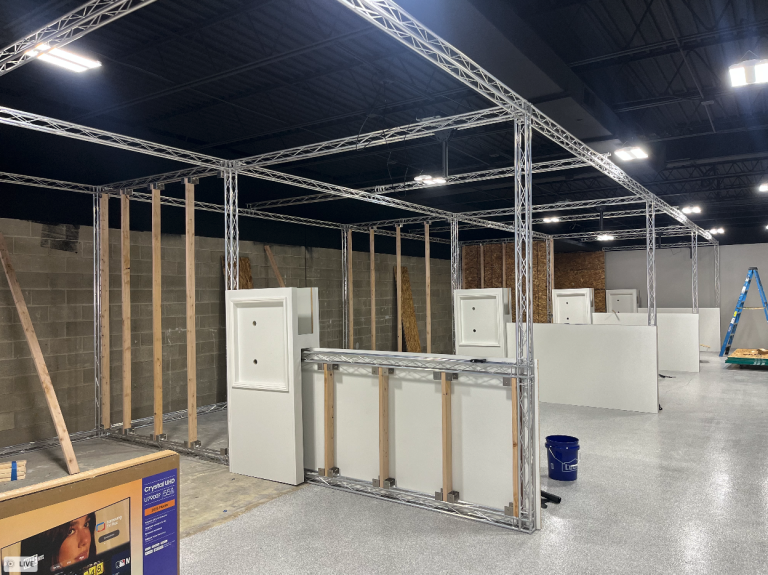
TruTruss XT™ is a 4” × 4” square aluminum truss system that assembles using connectors, pins, and R-clips. The system is designed to support impact screens, enclosure finishes, ceiling elements, projectors, radar units, and downstream trades such as electrical and flooring.
The system can be installed freestanding or mechanically anchored and is engineered for repeatability across bays and locations.
Truss Profile: 4” × 4” (100 mm × 100 mm) square
Material: EN-AW 6061-T6 aluminum
Manufacturing: Precision robotic welding
Welding Method: MIG
Tube Diameter: 20 mm (0.79 in)
Wall Thickness: 2 mm (0.08 in)
Brace Diameter: 6 mm (0.24 in)
Connections: Pin and R-clip system (v1)
Uniformly Distributed Load (UDL):
2 m (6.65 ft):
Total: 937.4 lb | 147.9 lb/ft | 0.5 in deflection4 m (13.12 ft):
Total: 537.9 lb | 41.0 lb/ft | 1.6 in deflection6 m (19.68 ft):
Total: 383.8 lb | 19.5 lb/ft | 2.4 in deflection8 m (26.24 ft):
Total: 246.7 lb | 9.4 lb/ft | 6.1 in deflection
Center Point Load:
2 m: 324.1 lb (0.3 in deflection)
4 m: 205.1 lb (1.0 in deflection)
6 m: 152.1 lb (2.4 in deflection)
8 m: 114.7 lb (4.7 in deflection)
Reduces installation time by approximately 50% versus traditional 2×4 framing (based on customer feedback)
Ensures bays are dimensionally identical and repeatable
Eliminates contractor guesswork
Simplifies coordination with turf, electrical, ceiling, and finish trades
- TruTruss XT is fully modular and designed for disassembly and relocation. Unlike permanent stick framing, the system becomes a reusable asset rather than sunk capital when a lease ends. In many municipalities, truss systems may be classified as fixtures rather than permanent structures (jurisdiction-dependent).
TruTruss XT v1 (Current)
Welded internal brackets for vertical 2×4 attachment
Supports drywall, MDF, and finish materials
Pin and R-clip connections
TruTruss XT v2 (In Development)
Bolt-on adapter system mountable anywhere on the truss
Supports vertical or horizontal 2×4 placement
Enables ceiling tile grids and enhanced aesthetics
Adapter system will have its own dedicated product page
Quick-Connect System (Patent Pending)
Replaces pins and R-clips
Faster truss-to-truss connections
Designed to further reduce install and teardown time
WHY TRUSIMSYSTEMS
TruSim Systems designs and manufactures modular infrastructure for golf and sports simulation environments. Our products are built for real-world installs, repeatability, and long-term ownership—not one-off builds.
We focus on systems that help operators scale faster, install cleaner, and protect capital.
DISCLAIMER
Load data is provided for reference only. Engineering requirements may vary by application, installation method, and local code. TruTruss XT™ v2 and quick-connect components are in development and subject to change.
FREQUENTLY ASKED QUESTIONS
Yes. TruTruss XT™ is designed to replace traditional 2×4 framing in commercial simulation bays.
Yes. The system is modular and designed for disassembly and reuse.
Yes. v1 supports vertical 2×4 attachment. v2 expands mounting flexibility.
Engineering requirements vary by application and jurisdiction.